No Place Like Home: How British Horror Found Its Darkest Territory on the End of Your Street
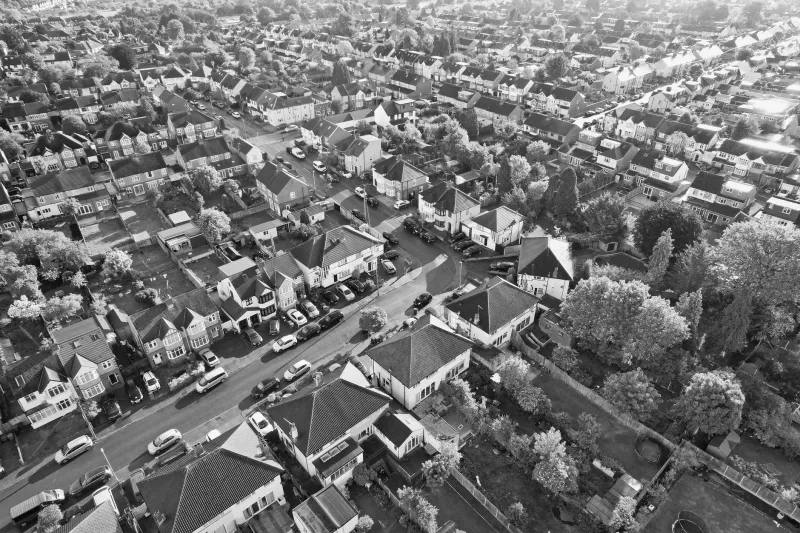
There's a particular kind of anxiety that only British people truly understand. It's the feeling you get when you've finally — finally — scraped together enough for a deposit, signed the mortgage papers, and moved into a new-build on the edge of a commuter town, only to realise something is very, very wrong. Not wrong in a chandelier-swinging, secret-passage, ancestral-curse sort of way. Wrong in a way you can't quite articulate. Wrong in the way your neighbour lingers a little too long at the fence. Wrong in the way the estate agent smiled when you asked about the previous occupants.
British horror has clocked this feeling, and it's running with it.
For decades, the haunted house as a horror device belonged almost exclusively to the grand and the gothic — Hammer's fog-drenched country piles, M.R. James's isolated rectories, the brooding ancestral seats of a thousand paperback covers. The terror was bound up in otherness. These were places most people would never live, attached to histories most people would never have. The horror was safely distant, architecturally and socially.
That distance has collapsed. And what's replaced it is considerably more unsettling.
The Cul-de-Sac as Crime Scene
What's striking about the wave of British domestic horror that's emerged over the past several years is how aggressively ordinary its settings are. We're talking about the kinds of homes that appear in Rightmove listings with phrases like "well-presented" and "ideal for a growing family." Pebbledash exteriors. Plastic-framed double glazing. Gardens that back onto other gardens. Streets where every house looks like a slightly different version of the one next to it.
This is, of course, the point. Horror functions through the violation of safety, and nothing signals safety to the contemporary British psyche quite like home ownership. Buying a house — particularly in the current market — is an act of almost heroic optimism. It represents stability, investment, arrival. To then suggest that the house itself is the source of danger is to pull the rug out from under everything.
Films like Barbarian demonstrated the concept internationally, but British horror has been doing something more culturally specific: rooting the dread in recognisably British spaces and recognisably British anxieties. The terrace. The semi. The new-build estate where the developer cut corners and the walls are thin enough to hear your neighbours breathing.
What's Behind the Kitchen Extension
Television has arguably been quicker than film to exploit this territory. Series that drop their horror into domestic settings — where the rhythms of school runs, supermarket trips, and weekend DIY create an almost suffocating sense of normalcy — have found that the contrast between the mundane and the monstrous does a huge amount of heavy lifting.
The conservatory, in particular, has become something of an unlikely icon of British domestic dread. That liminal glass room bolted onto the back of a house — neither properly inside nor outside, too hot in summer, too cold in winter, always slightly wrong — appears in contemporary British horror with a frequency that suggests filmmakers have identified it as the architectural embodiment of unease. It's the room where you're most exposed. Where the boundary between the private interior and the watching exterior is literally transparent.
Kitchen extensions tell a similar story. The knocking-through of walls to create open-plan living — that defining aspiration of British middle-class domesticity — removes the doors that once divided spaces and offered refuge. In horror terms, it eliminates the places to hide. The open-plan kitchen-diner, so beloved of property programmes, becomes a space with nowhere to run.
Property Anxiety and the Horror Next Door
It would be too reductive to say that British domestic horror is simply a metaphor for the housing crisis, but it would be dishonest to pretend the connection isn't there. The anxieties that contemporary British horror taps into — about ownership, about security, about what you don't know about the place you're pouring your life savings into — are anxieties that are acutely live right now.
There's a specific horror in the idea that your home has a history you weren't told about. That the survey didn't reveal everything. That the friendly couple at the viewing were friendly for a reason. British horror has always had a gift for weaponising social politeness — the horror of not wanting to make a fuss, of not wanting to seem difficult, of smiling back at the neighbour even when something feels deeply off — and the suburban setting gives that particular national neurosis room to breathe.
The neighbour, in fact, has become one of the defining figures of this subgenre. Not the obvious monster, but the person who is almost fine. Who brings a casserole when you move in. Who knows slightly too much about the previous residents. Who appears at the fence at odd hours with a reasonable explanation that you nonetheless can't quite accept.
The Ordinary Made Unbearable
What the best of this new British domestic horror understands is that the goal isn't to make viewers afraid of unusual places. It's to make them look differently at familiar ones. To watch one of these films or series and then go home to your own semi-detached, your own cul-de-sac, your own conservatory rattling in the October wind, and feel the faintest trace of doubt.
That's a harder trick to pull off than filling a screen with Gothic architecture and atmospheric mist, and the British horror creators doing it well deserve serious credit. They're working with the visual language of Homes Under the Hammer and Escape to the Country and finding the rot underneath the staging.
The horror isn't in the house at the end of a long, winding drive that you'd never be able to afford. It's in the house that looks exactly like the one you grew up in. The one with the same carpets, the same slightly-too-narrow hallway, the same garden fence that needs replacing.
That's the address British horror has moved into, and frankly, it's never been more at home.