Close the Curtains: Why British Horror Has Moved Its Monsters Into Your Living Room
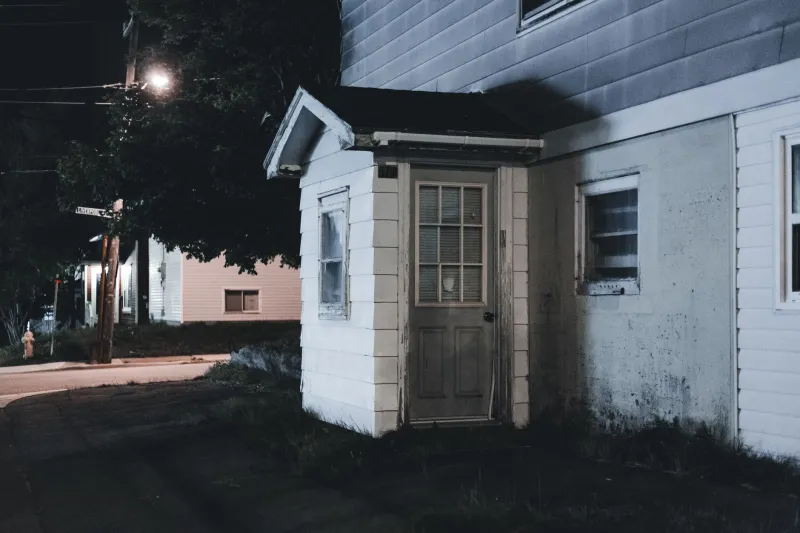
There's a particular kind of dread that comes from recognising your own front door on screen. Not because something monstrous is clawing at it from outside, but because the camera lingers just long enough to make you wonder what's already inside. That's the quiet, creeping power of British domestic horror — a strand of the genre that's been steadily sharpening its knives for years, and is now drawing blood in ways that gothic castles and isolated woodlands simply can't match.
We've always been good at the grand and the gloomy. Hammer built an empire on it. But there's a growing argument — and a growing body of work to back it up — that the most genuinely unsettling horror Britain is producing right now is set not in Transylvanian estates or remote Scottish highlands, but in pebble-dashed terraces, beige kitchens, and the kind of new-build estates where every house looks identical and the neighbours always seem just slightly too friendly.
The Ordinary as the Uncanny
What makes domestic horror so effective, particularly in a British context, is how ruthlessly it exploits familiarity. We know these spaces. The narrow hallway with the coat hooks. The kitchen extension that's always a bit too cold. The spare bedroom that nobody really uses but nobody ever talks about. When horror is set somewhere recognisable — somewhere that looks almost exactly like somewhere you've lived — the discomfort becomes personal in a way that no amount of gothic architecture can replicate.
Films like Possum and Censor understood this instinctively, using the mundane textures of British domestic life — council housing, worn carpets, the specific visual language of low-income family homes — to generate an atmosphere of profound wrongness. Nothing needs to leap out. The horror is in the wallpaper. It's in the way someone sits at a kitchen table and doesn't quite look up when you walk in.
Writers have been at this longer than filmmakers, it should be said. The British literary horror tradition has always had a domestic undercurrent — from the psychological claustrophobia of Daphne du Maurier's houses to the quietly devastating family dread in Ramsey Campbell's work. But something has shifted in recent years. The suburban setting has moved from backdrop to primary weapon.
What We Don't Know About Our Neighbours
One of the most potent anxieties driving contemporary British domestic horror is the erosion of genuine community knowledge. We live closer to more people than at almost any point in history, and we know less about them than ever. The neighbour who waves from the driveway every morning. The couple down the road whose arguments you half-hear through the wall. The family that moved in six months ago and keeps odd hours.
This is fertile ground, and British horror knows it. The genre has always been a reliable barometer for social anxiety, and right now the needle is pointing firmly at the home as a site of hidden threat. Privacy — or rather, the performance of it — has become genuinely frightening. We curate what we reveal. We close the blinds. We smile and say we're fine.
Several recent British horror productions have leaned hard into this idea, using the suburban setting not just as atmosphere but as active commentary. The houses in these stories aren't haunted by ghosts in the traditional sense — they're haunted by secrets, by the slow accumulation of unspoken things, by the distance between what a family presents to the world and what actually happens behind the front door.
The Kitchen Table as Crime Scene
There's also something to be said for the specific geography of British domestic horror. It tends to be resolutely unglamorous. These aren't the sleek, glass-walled American homes that populate Hollywood horror — spaces so large and architecturally dramatic that the danger feels almost earned. British domestic horror operates in smaller, tighter spaces. The terror is compressed. There's nowhere to run that isn't immediately recognisable, immediately ordinary.
The kitchen in particular has become something of a recurring location. It makes a certain kind of sense. Kitchens are where British families actually live — where arguments happen, where silence is loudest, where the performance of normality is most insistently maintained. A sharp knife on a chopping board in a well-lit kitchen carries a different charge to the same object in a dungeon. Context is everything, and British domestic horror has become masterful at weaponising context.
Bedrooms, too, carry specific weight. The intimacy of sleep, the vulnerability of the body at rest, the darkness that's supposed to be safe — these are spaces that British horror is increasingly willing to violate, not with supernatural intrusions necessarily, but with the far more unsettling presence of another person who shouldn't quite be trusted.
Modern Anxieties in a Three-Bed Semi
It would be reductive to read all of this purely through a sociological lens, but it would be equally naive to ignore what these stories are responding to. Britain has spent the last decade and a half in a state of sustained domestic anxiety — financial precarity, housing insecurity, the slow fraying of institutions that people once trusted. The home, which is supposed to represent safety and stability, has become for many people a source of profound stress.
Horror has always metabolised what the culture can't quite say out loud, and British domestic horror is doing exactly that. The threat in these stories rarely arrives from outside. It's already in the house. It's been there the whole time. That's not just a narrative device — it's a fairly accurate description of how a lot of people in this country feel about their own lives.
The genre is also, it's worth noting, increasingly interested in who gets to feel safe at home and who doesn't. Domestic horror written and directed by women, or centred on women's experiences, has a particular sharpness to it — an understanding that the home has never been an uncomplicated refuge for everyone who lives in it. That thread runs through some of the most interesting work being made right now.
The Scene Is Watching
What's exciting, from where we're sitting, is that this doesn't feel like a trend that's about to exhaust itself. If anything, the domestic horror space feels like it's just getting started. Budgets don't need to be enormous — a house, a small cast, and a genuine understanding of how dread accumulates in confined spaces is enough. That's a genuinely democratic form of filmmaking, and Britain has the talent to run with it.
The moors aren't going anywhere. The gothic tradition isn't dead. But right now, the most vital horror in this country is being made in the kinds of houses most of us actually live in. And that, if you'll excuse the expression, is terrifying.