They Made Us Read This: The British Horror That Haunted the Classroom
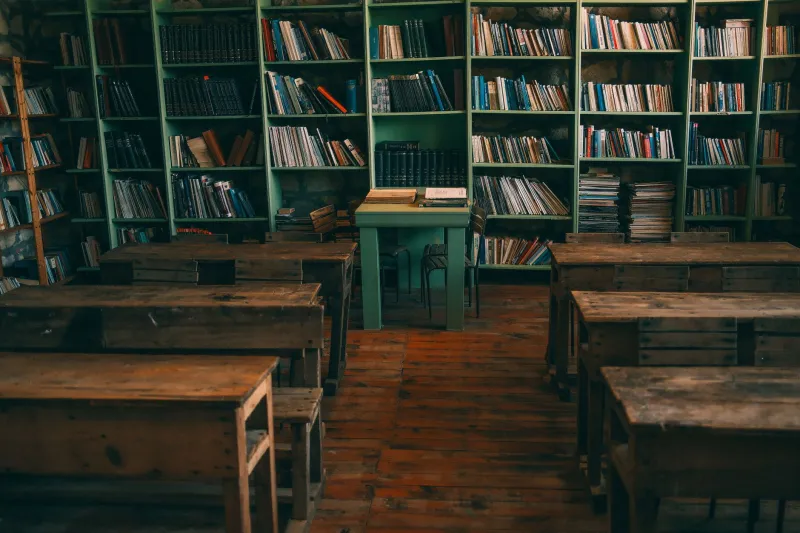
There's a particular kind of dread that belongs only to childhood. Not the dread of adult responsibility or financial ruin — something rawer, more primal. The dread of the story your teacher handed you on a Tuesday afternoon that you couldn't stop thinking about on Friday night. Britain, almost uniquely among nations, decided that this feeling was not only acceptable but educational. And for decades, schoolchildren across the country were handed books, sat in front of televisions, and ushered into darkened halls to watch things that would leave marks lasting well into adulthood.
This wasn't accidental. It was, in its own peculiar British way, entirely deliberate.
Roald Dahl and the Comfortable Cruelty of the Curriculum
Ask almost any British person of a certain age what horror they first encountered in school, and Roald Dahl's name will surface within seconds. Not the Dahl of Charlie and the Chocolate Factory — that's the version parents are comfortable with. The Dahl that haunted classrooms was darker, stranger, and considerably less interested in happy endings.
Danny the Champion of the World has its warmth, certainly. But The Witches — which appeared on reading lists across the country throughout the eighties and nineties — is a genuinely disturbing piece of work. The Grand High Witch's face-peeling scene, the idea that ordinary women around you might secretly despise children, the protagonist's permanent transformation into a mouse: none of this resolves neatly. Teachers assigned it anyway, often with an enthusiasm that suggested they rather enjoyed the reaction it produced.
Dahl's Tales of the Unexpected — adapted for ITV and frequently screened in secondary school media studies classes — pushed further still. These were adult stories, technically, but nobody seemed particularly fussed about that distinction. Pupils sat watching tales of murderous spouses, grotesque revenge, and psychological collapse, then were asked to write essays about narrative structure. The horror was almost incidental. Almost.
The BBC's Quietly Disturbing Gift to Children's Television
If Dahl was the literary vector, the BBC was the broadcast one. British children's television from the seventies through to the nineties operated on a peculiar assumption: that children were perfectly capable of handling genuinely unsettling material, provided it was wrapped in the right packaging.
The Stone Tape (1973) was technically an adult drama, but it found its way into schools often enough to have scarred whole cohorts of media studies students. Nigel Kneale's story of a research team encountering ancient evil in a Victorian house remains one of the most effectively disturbing things ever broadcast on British television. Watching it in a classroom, on a wheeled-in television with a fuzzy picture, somehow made it worse rather than better.
More specifically aimed at younger audiences was Chocky (1984), adapted from John Wyndham's novel for ITV. The story of a boy with an alien presence in his mind sounds benign enough in summary. In execution, it was quietly horrifying — the scenes where Matthew loses control of himself, speaking in a voice that isn't his own, disturbed children in ways that took years to fully articulate.
Then there's The Children of Green Knowe (1986), the BBC adaptation of L.M. Boston's novel. A lonely boy at a remote manor house, ghost children appearing and disappearing, an atmosphere of beautiful melancholy that occasionally curdled into something far more threatening. It was assigned reading in numerous primary schools. The television adaptation turned up on afternoon schedules. Neither version was remotely safe.
Ghost Stories and the English Literature Classroom
The ghost story tradition sits at the heart of English literature, and British schools leaned into this with considerable commitment. M.R. James was — and in many schools, remains — a staple of the curriculum. His stories, written for a scholarly adult audience in the early twentieth century, have a creeping dread that translates perfectly to a classroom reading exercise.
Oh, Whistle, and I'll Come to You, My Lad in particular became a rite of passage. The image of a figure made of crumpled bedsheets pursuing a man across a beach is so economically horrible that it lodges permanently. Teachers who assigned it often did so in winter terms, when the light failed early and the walk home from school was properly dark. Whether this was pedagogical strategy or mischief is a question that probably doesn't need answering.
Susan Hill's The Woman in Black joined the curriculum later, its theatrical adaptation becoming a school trip staple that reliably produced screaming from rows of fourteen-year-olds who had absolutely convinced themselves they were too old to be frightened. They were not too old. Nobody is too old.
Why Did British Education Embrace the Dark?
This is the question that genuinely distinguishes the British approach from almost anywhere else. American schools, broadly speaking, treated horror as something to be kept away from children. British schools treated it as something children needed to encounter, preferably under supervision.
Part of this comes from the Gothic tradition being so deeply embedded in British literary culture that excluding it would mean excluding huge swathes of the canon. You cannot teach nineteenth-century literature without encountering Frankenstein, Dracula, The Turn of the Screw, Strange Case of Dr Jekyll and Mr Hyde. These aren't peripheral texts — they're central ones.
But there's something else, too. A strand of British educational thinking held that encountering fear in a controlled environment — a classroom, a school hall, a set text — was genuinely useful. It taught children that fear was survivable. That the thing in the story, however terrible, could be closed between covers and put back on the shelf. That the credits would eventually roll.
Whether this produced a generation of psychologically resilient adults or simply a generation of adults with very specific and persistent nightmares is, perhaps, a matter of perspective.
The Haunting That Never Really Leaves
Talk to British horror fans — and we talk to quite a few of them here — and the school-era scares come up again and again as foundational experiences. Not just as embarrassing memories, but as genuine starting points. The moment a book assigned for homework turned out to be about something genuinely terrifying. The afternoon a teacher wheeled in the television and pressed play on something that had no business being shown to a room full of eleven-year-olds.
These experiences didn't put people off horror. They did the opposite. They demonstrated, at an age when such demonstrations really stick, that fear could be compelling. That darkness in a story wasn't a flaw to be avoided but a quality to be sought out. That the best narratives didn't always resolve comfortably, and that this lack of resolution was part of what made them memorable.
British horror's current strength — the films, the television, the literature, the podcasts and theatre productions and independent publishers — owes something significant to the teachers who handed out the wrong book, or pressed play on the slightly-too-disturbing film, or read aloud from M.R. James on a dark November afternoon.
They probably thought they were just covering the curriculum. What they were actually doing was building the audience.